
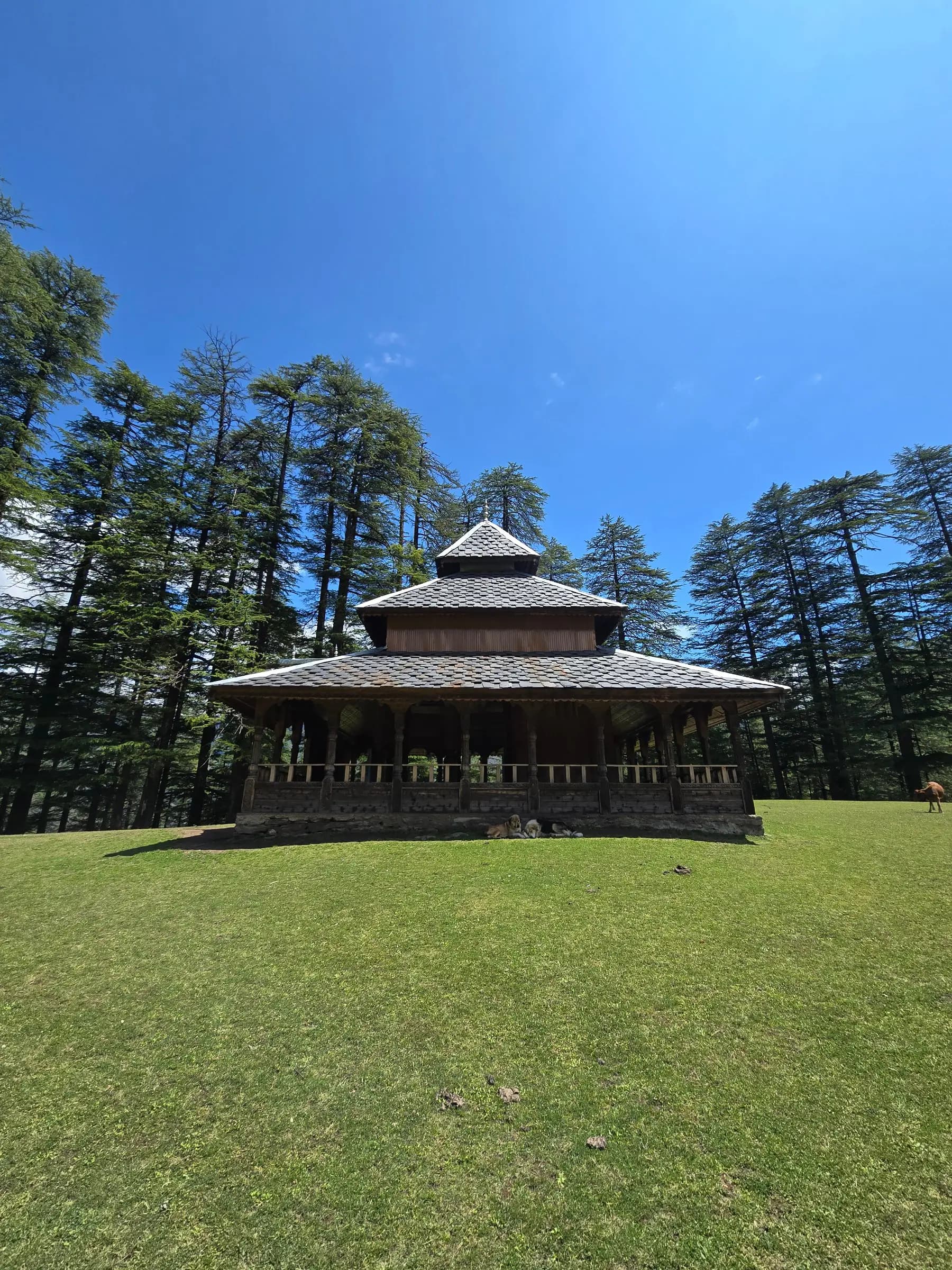
Shangarh is a meadow village, not a hotel town. Village homestays, the Sainj Valley road, Sainj town and Aut–Banjar compared, with typical prices, parking and season notes.
Quick summary
For a first trip to Shangarh, stay in a village homestay at the edge of the meadow, a short walk from the Shangchul Mahadev temple and the deodar forest. If the village is full, or you want more comfort or easier parking, the villages along the Sainj Valley road are the next choice, with Sainj town and then Aut or Banjar as fallbacks. Shangarh has no hotel district, so the real decision is between a homestay, a small guesthouse and a camp. Once you have picked, compare live hotel prices in Shangarh for your dates.
Shangarh stay areas at a glance
| Area | Best for | Feel | Typical room per night with meals | Distance to the meadow |
|---|---|---|---|---|
| Meadow edge and village homestays | First-timers, couples, walkers | Slate-roofed village, temple at the door | about ₹1,000–2,500; best rooms about ₹2,500–4,500 | On foot, 2–10 minutes |
| Sainj Valley road villages (Ropa, Shainsher, the Barshangarh side) | Families with a car, trekkers heading for the park | Scattered hamlets and roadside cottages | about ₹1,200–3,000 | A short drive or a long walk |
| Sainj town | Late arrivals, bus travellers, tight budgets | Small market town with the valley's last ATM and fuel | basic rooms, generally below village homestay rates | About 12 km, 45–60 minutes uphill |
| Aut and Banjar | Night halts, mixing Sainj with Tirthan | Highway junction (Aut); Tirthan valley town (Banjar) | about ₹1,000–3,500 | Aut about 32 km; Banjar in the next valley |
Prices are typical 2025–2026 rates for a double room with dinner and breakfast outside long weekends; almost every stay includes meals because there are only a handful of places to eat. Rates rise on long weekends in April–June and around New Year, and many hosts close from mid-December to February.
Meadow edge and village homestays
Shangarh village sits at about 2,200 metres on a shelf above the Sainj river, with the sacred meadow at its centre and the kath-kuni temple of Shangchul Mahadev at one edge. Homestays are family houses with two to six guest rooms, some in old wood-and-stone buildings with carved balconies, others in newer concrete blocks beside them.
Who it suits: first-time visitors, couples, solo travellers and walkers.
What to expect: clean but basic rooms, shared or attached bathrooms, hot water from geysers that depend on the power supply, thin walls and home-cooked food at fixed times. Power cuts are common and most houses lack full backup. Heating means blankets, a bukhari in the common room or a small electric heater on request. Mobile signal is weak, so download maps before you arrive, and there is no ATM in the village.
Downsides: on long weekends the village fills and quiet goes first. The meadow has rules: no shoes on the sacred end of the grass, no tents, no fires, no alcohol, no meat cooked nearby and no loud speakers. The village panchayat fines people who ignore them.
By car: most houses are reached by lanes and steps. Cars stop on the road at the top of the village or in small cleared patches, so ask exactly where you will park and how far you will carry bags. Read the Shangarh travel guide for the meadow's customs before you book.
Sainj Valley road villages: Ropa, Shainsher and the Barshangarh side
Below and around Shangarh, hamlets along the Sainj Valley road and the side road towards the Barshangarh waterfall have picked up cottages, small guesthouses and camps as the village has filled. Ropa, on the main valley road, is where the Great Himalayan National Park's Sainj range office issues core-zone permits; Neuli, about 3 km beyond it, is where the park trails begin, and Shainsher sits on the forest roads above.
Who it suits: families with a car who want a driveway rather than a lane, trekkers entering the park from Neuli, and anyone who prefers a private cottage to a room in a family home.
Downsides: you are not in Shangarh, so evenings on the meadow mean a drive each way on a narrow road. Camps on the forest fringe are the only legal camping option, but they are the coldest choice in bad weather and the first to close when it snows.
By car: the easiest part of the valley to drive to. Roadside properties usually have a flat patch for a few cars; confirm it rather than assume.
Sainj town
Sainj is the small market town about 12 km below Shangarh where the valley road leaves the Aut–Larji highway. It has the last fuel pump, the valley's ATMs, shops and a few basic lodges. Local buses and shared taxis to Shangarh start here.
Who it suits: late arrivals who should not drive the last stretch after dark, bus travellers seeing the meadow as a day trip, and tight budgets.
Downsides: a functional town with road noise and little charm; room standards vary.
By car: easy, with roadside parking. Fill the tank, draw cash and check the road status before the climb.
Aut and Banjar as fallbacks
Aut is the highway junction on the Chandigarh–Manali road where the Sainj and Tirthan valleys branch off, with basic hotels near the tunnel. Banjar is the main town of the Tirthan side, with far more hotels, homestays and riverside resorts than the Sainj side. Neither is a base for Shangarh so much as a halt for drivers arriving after 11 to 12 hours from Delhi, or a way of combining Shangarh with Tirthan on a four-day trip.
Downsides: an extra hour or more of driving each way, and in Banjar the long weekend crowds that Tirthan now attracts.
Homestay, guesthouse or camp?
- Homestays are the default and the best fit for the village. Meals are included, hosts know the trails and the rules, and a family member will often walk with you to Barshangarh or Pundrik Rishi Lake.
- Small guesthouses and cottages offer more privacy, attached bathrooms, better heating and more reliable hot water, at about ₹2,500–4,500 a night for the best rooms. They suit families with older parents.
- Camps are allowed only on private land outside the meadow's sacred boundary. They work for groups from March to June and in October, and are usually closed in snow. Ask whether the price is per person or per tent and whether meals are included.
Booking realities
- Only part of Shangarh's supply is on the booking platforms; many homestays take bookings by phone or WhatsApp with a small advance by UPI. Confirm the room, meal plan and price in a message so there is a record.
- Carry cash from Sainj or lower down. UPI works only when the network does, and cards are rarely accepted.
- Ask three questions before paying: where the car stops, whether the room has a heater and morning hot water, and whether the house has power backup.
- On long weekends in May and June, book two to three weeks ahead. On ordinary weekdays, arriving without a booking usually works, except in the snow months.
Season notes that change where to stay
- Spring and early summer (March–June): the meadow is in flower and the weather clearest; the village is the first choice. Long weekends are the busy exception.
- Monsoon (July–mid-September): landslides hit both the Mandi–Aut highway and the Sainj Valley road, and trails turn slippery. Stay in the village rather than a camp, keep a buffer day and avoid rooms right above the river.
- Autumn (late September–November): colour, clear skies and thin crowds; nights drop towards freezing by November, so ask about heating.
- Winter (December–February): snow falls mostly in January and February. The road to Sainj stays open, but the climb to Shangarh can be blocked for a day or two after a heavy fall, camps close and several homestays shut. Choose a house with heating and power backup, keep a night in Sainj or Aut in reserve, and never attempt the last stretch after dark or on fresh snow without chains.
- Great Himalayan National Park ecozone: Shangarh lies in the park's ecozone, which needs no permit, but trekking into the core zone from Neuli does. Permits come from the Ropa range office or the Shamshi head office, and multi-day treks need registered guides.
Driving from Delhi and the last stretch
The drive is about 500 km and 12 hours via Ambala, Kiratpur, Bilaspur and Mandi to Aut, then 20 km up the Sainj valley to Sainj town and roughly 12 km of narrow, steep, single-lane road with tight hairpins to the village. Drive the last stretch in daylight. See the Delhi to Shangarh by road guide for tolls, fuel and stops, and the Shangarh trip cost guide for what two nights add up to on each budget.
For what to do there, read the best places to visit in Shangarh and the 2-day Shangarh itinerary, and use the Shangarh trip planner to build the days around your base. If you are continuing to Manali, see where to stay in Manali. When you are ready to book, compare live hotel prices in Shangarh for your area and dates.
FAQs
Where should you stay in Shangarh for the first time?
In a village homestay at the edge of the meadow. The temple, the grass and the forest walks are on foot, hosts explain the meadow's rules, and meals are included.
Are there hotels in Shangarh?
Not in the usual sense. Shangarh has homestays, a few small guesthouses and cottages, and camps on private land below the village. The nearest conventional hotels are in Sainj, Aut and Banjar.
Is Shangarh safe to stay with family?
Yes, with the right expectations. The village is quiet and welcoming, but rooms are basic, heating is limited and the last stretch of road is narrow. Families with young children or older parents do best in a guesthouse or cottage with attached bathrooms, heaters and power backup.
Can you stay in Shangarh in winter?
Yes, with fewer options. Snow falls mostly in January and February, several homestays and all camps close, and the Sainj to Shangarh road can be blocked for a day or two after a heavy fall. Book a house with heating and backup, carry chains and keep a fallback night in Sainj or Aut.
Can you camp on Shangarh meadow?
No. The meadow belongs to the village deity; tents, fires, alcohol and loud music are banned on it, with fines for those who ignore the rules. Camping is allowed only at private campsites outside the sacred boundary.