
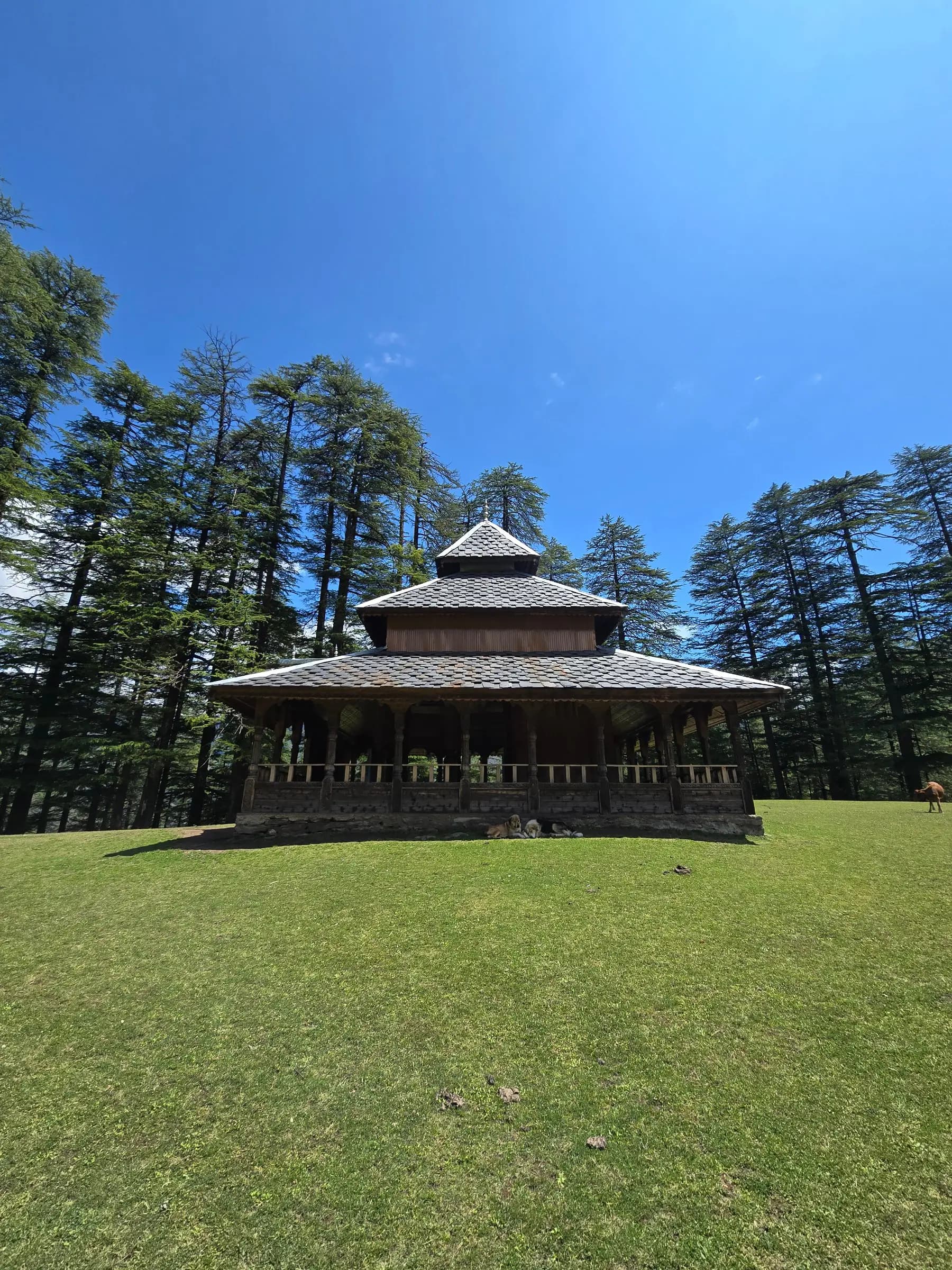
How to do Shangarh from Delhi NCR: the Manali road to Aut and the Sainj valley, the last 12 km, when to go, the meadow's rules and why they matter, homestays versus camps, the Barshangarh and Pundrik Rishi walks, the GHNP gate, food, costs and the Tirthan comparison.
Shangarh in brief
Shangarh is a village of about 40 households on a shelf at roughly 2,200 metres in the Sainj valley of Kullu district, Himachal Pradesh, about 500 km from Delhi, at the edge of the Great Himalayan National Park's buffer zone. It is known for a flat sacred meadow belonging to the village deity, a fine kath-kuni temple with a tradition of sanctuary, deodar forest, and a quiet that the neighbouring Tirthan valley has largely lost. It has homestays, a few roadside camps, dhabas, and rules.
How to reach Shangarh from Delhi NCR
By car or motorcycle
Delhi – Ambala – Chandigarh bypass – Kiratpur – Bilaspur – Mandi – Aut tunnel exit at Larji – Sainj – Shangarh, about 500 km. The four-lane to Nerchowk and the Mandi road to the Aut tunnel take 9 to 10 hours; take the exit before the tunnel for Larji rather than going through, and follow the Sainj river 20 km to Sainj town, 40 minutes. The last 12 km from Sainj to Shangarh are narrow, steep and hairpinned with a variable surface, 45 minutes in daylight, and should not be attempted in the dark on a first visit. Total 11 to 12 hours; leave Delhi by 4 am or break at Mandi. Fuel at Sainj; there is nothing above.
By bus
Overnight HRTC or private Volvos from Delhi to Manali or Kullu stop at Aut on request, 10 to 11 hours, 1,000 to 1,600; from Aut, local buses and shared jeeps run to Sainj, and shared jeeps from Sainj to Shangarh a few times a day for 50 to 80. Or HRTC to Mandi and local buses on. Allow half a day for the last 32 km by public transport.
Best time to visit
March to June: the meadow greens and flowers, the skies are clear until afternoon, Barshangarh is full from snowmelt, and May weekends bring Chandigarh's cars. Days of 15 to 25, nights around 5. July to mid-September: monsoon, leeches on the trails, the Sainj road prone to slips, and the valley green and empty. Late September to November: the best; walnut and apple harvest, gold meadow, clear cold mornings, and thin crowds after Diwali. December to February: snow on the meadow and the road, homestays half-closed, and a beautiful silence for those who can reach it; check the road from Sainj before leaving.
The rules of the meadow
Shangarh is a village whose holiest ground is a field it lets visitors walk on. The deota's terms, enforced by the villagers: no camping on the meadow, no fires, no shoes on the sacred section by the temple, no alcohol, no loud music, no littering, and no quarrels or raised voices, because the ground is a place of peace and sanctuary. The temple courtyard requires bare feet, covered heads and no leather. Villagers will tell you once politely; the second time is not a request. Every visitor who keeps these keeps Shangarh what it is; the camps on the road below exist because people did not.
Where to stay
Village homestays
Kath-kuni and newer houses in the lanes above the meadow, 800 to 2,500 a night with home-cooked meals, run by families who will walk with you, cook siddu and explain the temple. The right choice, and the money stays in the village.
Roadside camps and guesthouses
A growing strip of tented camps and small hotels on the road below the meadow, 1,000 to 3,500, with bonfires and, sometimes, the music the meadow forbids. Convenient for those with cars; less of the village.
Sainj and the valley
Guesthouses in Sainj town and at Ropa on the way up, 700 to 2,000, for those arriving late and climbing in the morning.
The walks
- Barshangarh waterfall: 8 km through forest and two hamlets to a tall fall in a gorge, three hours each way, a local guide useful. The full day.
- Pundrik Rishi lake: down to Sainj by road, an hour's walk up to the sacred pond above Deohari. The second morning.
- The meadow perimeter and the village lanes: an hour at dawn or dusk.
- Forest road to Shenshar: a few kilometres along the ridge to the next village and its temple, easy, with views back over the meadow.
- Neuli and the GHNP buffer: 24 km by road via Sainj to the park gate and a few kilometres into the forest on foot; multi-day treks to Shakti, Maror and beyond with a permit and a registered guide.
The temple
Shangchul Mahadev is the village deota and his temple at the meadow's edge is a kath-kuni building of alternating deodar and stone with carved eaves, doors and pillars, a slate pagoda roof and a tradition of asylum that the village states plainly. Visit at dusk, barefoot, head covered, no leather, and ask before photographing inside. The gur, the oracle, speaks for the deota at fairs and disputes; the spring fair brings the god out in his palanquin and the valley in.
Food
Homestay food is the food: siddu, the steamed stuffed bread, with ghee and walnut chutney; Kullu rajma with rice; sepu vadi; trout from the Sainj when the family can get it; and dham on request for a group. Dhabas by the road do Maggi, parathas and thalis. Sainj town has the last proper shops. Ask for dinner the evening before; nothing is on a menu.
Getting around
Shangarh is on foot. Shared jeeps run to Sainj a few times a day; private taxis from Sainj are 600 to 1,000 to the village and 1,500 to 2,500 for a Neuli or Pundrik Rishi half-day. Motorcycles suit the Sainj road; cars manage it in daylight with care. There is no scooter hire; bring your own wheels or use the jeeps.
Shangarh and Tirthan
The Tirthan valley, over the ridge to the south, has a national park gate, trout, riverside homestays and, now, several hundred rooms, weekend traffic and a cafe culture. Shangarh is what Tirthan was a decade ago: one meadow, one temple, forty families and rules. If you want a river to sit by and a choice of restaurants, Tirthan is 30 km away. If you want a village that has not yet decided to become a destination, Shangarh is it, for now, and how visitors behave will decide how long.
Practical notes
- Cash for everything; the ATM is at Sainj and UPI works when the network does, which is intermittently.
- Fuel at Sainj.
- Do not drive the last 12 km in the dark on a first visit.
- Learn the meadow's rules before you walk on it.
- Ask before photographing people, houses and the temple interior.
- Carry your rubbish down to Sainj; the village has no disposal.
- GHNP permits are from the Sainj office or registered guides; do not walk into the core without one.
Traps to avoid
- Pitching a tent on the meadow because it looks like a campsite.
- A roadside camp with a speaker.
- The last 12 km after sunset.
- A long weekend in May expecting solitude.
- Treating the temple's sanctuary tradition as folklore; the village does not.