
How to do Jaisalmer from Delhi NCR: the long train and road options, when to go, where to stay and why not inside the fort, the havelis and the desert, Khuri versus Sam, Kuldhara, Longewala, costs and how many days it takes.
Jaisalmer in brief
Jaisalmer is a town of about 70,000 in the far west of Rajasthan, roughly 770 km from Delhi and 100 km from the Pakistan border. It was founded in 1156 as a Bhati Rajput stronghold on the caravan route between India and Central Asia, grew rich on trade in the 18th and 19th centuries, and faded when the sea routes and Partition killed the caravans. What is left is a living sandstone fort, the finest merchant havelis in Rajasthan, and the Thar desert beginning at the edge of town.
How to reach Jaisalmer from Delhi NCR
By train
The Delhi–Jaisalmer Express and the Runicha Express leave Delhi in the late afternoon or evening and reach Jaisalmer the next morning or midday, about 17 to 19 hours via Jaipur and Jodhpur. Sleeper to 2AC is 500 to 2,500 rupees. It is a long ride but you sleep through most of it, and it is the only sensible way to do Jaisalmer in a long weekend.
By car or motorcycle
Two routes, both long. Via Jodhpur: Delhi – Jaipur – Ajmer – Pali – Jodhpur – Pokhran – Jaisalmer, about 770 km, 15 to 17 hours of driving. Break at Jodhpur; the Jodhpur to Jaisalmer stretch of 280 km is a superb, empty desert highway. Via Bikaner: Delhi – Hisar – Fatehpur – Bikaner – Pokhran – Jaisalmer, about 800 km, quieter roads through Haryana and Shekhawati, breaking at Bikaner. On a motorcycle, two riding days each way is the minimum; three lets you enjoy it. Do not ride the Pali or Pokhran stretches after dark.
By air
Jaisalmer airport has seasonal direct flights from Delhi in winter, about 90 minutes, 5,000 to 12,000 rupees. Otherwise fly to Jodhpur and drive or take the train for the last 280 km.
Best time to visit
November to February is the season: warm days of 22 to 28 degrees, nights on the dunes near 5 degrees or below, clear skies, and the Desert Festival in February. October and March are hotter but workable. April to September is 40 to 46 degrees with dust storms in May and June and a thin monsoon; most camps close. Do not come in summer unless you have a specific reason and a car with air conditioning.
Where to stay
The town below the fort
Guesthouses, havelis and boutique hotels in the old town lanes around Gandhi Chowk, the havelis and Gadisar, 1,200 to 8,000 a night, most with rooftops facing the fort. Five minutes' walk to everything. This is where to stay.
Inside the fort
Guesthouses in the fort lanes, 1,500 to 6,000, atmospheric and much-photographed. The fort's medieval drainage cannot handle hotel wastewater, and several bastions have collapsed over the past decades. Conservationists ask visitors not to stay inside, and I agree; the view from a rooftop in the town below is better anyway because you can see the fort.
Desert camps
Khuri: small camps and homestays with huts or tents, 1,500 to 4,000 per person including dinner, breakfast and a camel to the dunes. Sam: large camps with Swiss tents, dinner shows and often DJs, 3,000 to 10,000 per person. A few quiet luxury camps sit away from both strips at 10,000 upwards.
Heritage and luxury
Converted havelis and a couple of palace-style hotels around town and on the outskirts, 8,000 to 30,000.
The fort and the havelis
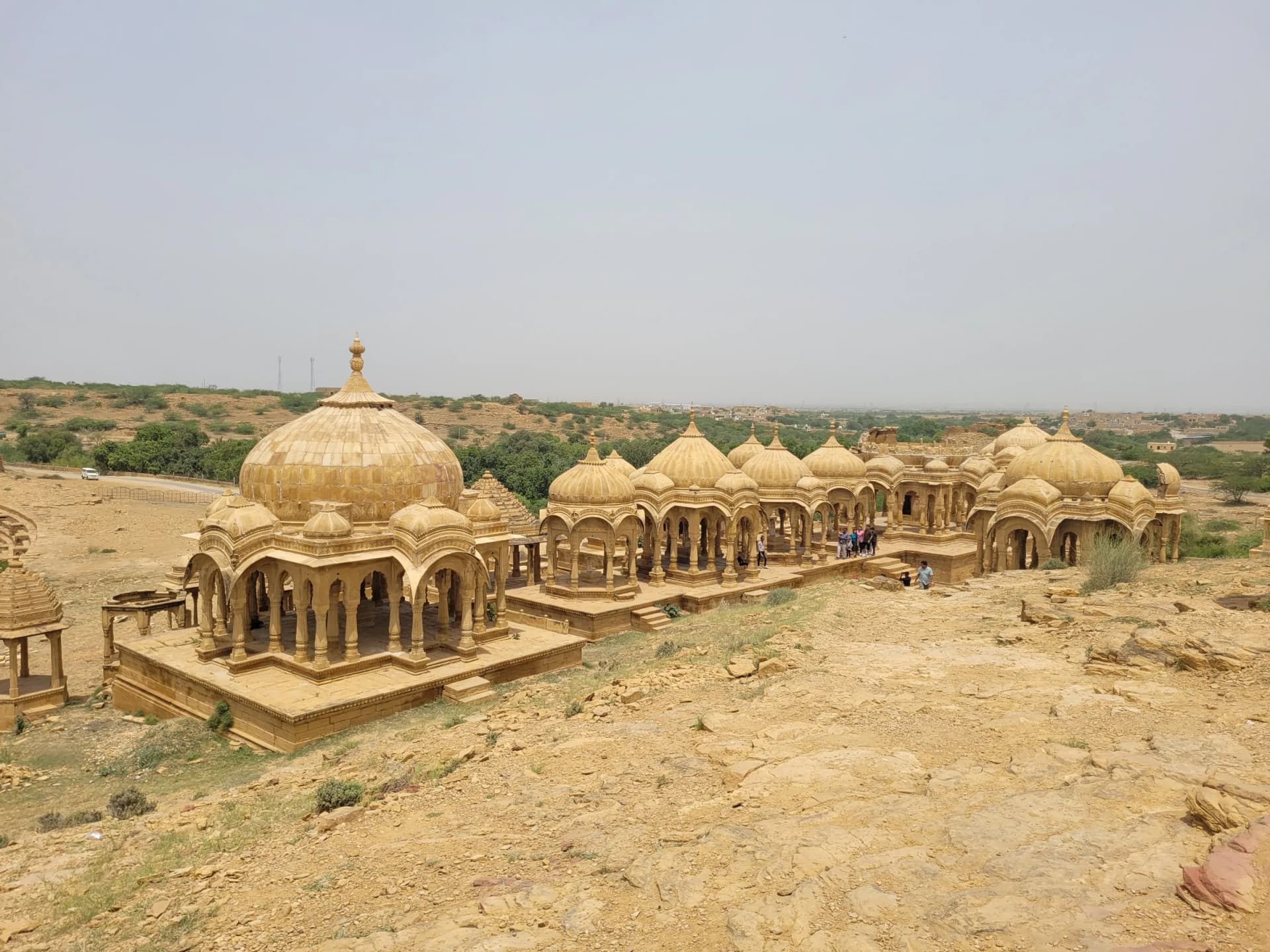
Walk into the fort at 7 am. Two hours for the Jain temples, which open in the morning, the Raj Mahal palace museum and the western ramparts. Then the havelis in the town: Patwon ki Haveli's lane in morning light, with the private haveli museum for interiors; Salim Singh with its peacock brackets; Nathmal carved by two brothers from opposite ends. Gadisar Lake for sunset or sunrise. Vyas Chhatri or Bada Bagh for the classic sunset over the town and desert.
The desert: Khuri versus Sam
Sam has the big dunes and the big scene: hundreds of camps, jeeps and camels at sunset, dinner shows, DJs. Khuri has smaller dunes, a village, small camps and silence. For a night in the desert, Khuri. For the biggest-dune photograph, an hour at Sam at sunset, then leave. Whatever you book, ask about music; a no-DJ camp at Sam exists but you have to find it. Kuldhara, the abandoned village, is on the road to both and is the sunset stop before the dunes.
The long ride to the border
Longewala, 110 km north-west, has the war memorial to the 1971 battle, with tanks, bunkers and a small museum, in the middle of absolutely nothing. Tanot Mata temple, 120 km, is the BSF-run shrine near the border where unexploded Pakistani shells are displayed. Together they make a 250 km day on straight empty roads through the Desert National Park scrub. Carry water, fuel up in Jaisalmer and Ramgarh, and expect checkpoints. On a motorcycle this is one of the great rides in the country.
Food
Desert food built on what grows in sand: ker sangri, dried beans and berries cooked with spices; bajra roti with ghee and garlic chutney; gatte ki sabzi; dal baati churma; and laal maas in the non-vegetarian places. The small thali restaurants below the fort do all of it for 200 to 400. Rooftop restaurants with fort views do Indian, Italian and everything else for tourists at 500 to 900. Skip the bhang lassi shops, which are legal, aggressively marketed and a good way to lose a day.
Getting around
The town is on foot. Autos are cheap. For the desert, a cab for the afternoon to Kuldhara and Khuri or Sam is 1,500 to 2,500; most camps include pick-up from town. For Longewala, a cab is 3,500 to 5,000 for the day. Motorcycles and scooters can be hired in town for 500 to 1,500 a day and are the best way to do the desert roads.
How long to stay
Three nights at minimum: one in town for the fort and havelis, one in the desert at Khuri, one more in town for Bada Bagh and Gadisar and a slow morning. A fourth night allows the Longewala day. With the train each way, that is a five-day trip from Delhi; on a motorcycle via Jodhpur, plan a week.
Practical notes
- Desert nights are cold, 3 to 8 degrees in December and January. The camps give blankets; bring a jacket and socks.
- Sun is strong even in winter. Hat, sunscreen, two litres of water.
- ATMs, cards and network work in town; carry cash for camps and villages.
- Fuel up in Jaisalmer before any desert ride; pumps are sparse.
- Carry ID for checkpoints on the Longewala and Tanot roads.
- Camp touts meet trains and buses. Book ahead or walk past them.
Traps to avoid
- The default Sam camp package with a DJ and 300 other guests.
- Staying inside the fort.
- Bhang lassi on your only full day.
- The camel safari that turns into a two-day march when one sunset ride would do.
- Delhi to Jaisalmer in one push by road.