
The places to visit in Jaisalmer worth your time, ranked with time needed, opening hours and best hour of day: the fort, Khuri, Patwon ki Haveli, Kuldhara, Bada Bagh, Gadisar and Sam.
Quick summary
Jaisalmer is small enough to cover in two or three days and far enough from Delhi that every hour on the ground should count. This list ranks the places to visit in Jaisalmer by how much they add to a short trip, with the time each one needs and the hour of day that suits it, because in the desert the light decides everything. For routes, seasons and costs, start with the Jaisalmer destination guide.
Top picks at a glance
- For a first morning: Jaisalmer Fort at 7 am, Jain temples from 8, then Patwon ki Haveli.
- For the desert night: Khuri Dunes, with Kuldhara on the way out in the last hour of light.
- For the big-dune photograph: Sam Sand Dunes for an hour at sunset.
- For sunrise: Bada Bagh, 6 to 7 km north of town.
- For a slow hour: Gadisar Lake at dusk and Salim Singh Ki Haveli on the walk back.
1. Jaisalmer Fort
What it is: the yellow sandstone fort on Trikuta hill, founded in 1156 by Rawal Jaisal and inscribed in 2013 as part of the UNESCO Hill Forts of Rajasthan. Four gateways lead up a ramp to the main square below the Raj Mahal, the former palace, which is now a museum. About a quarter of the old city's population still lives inside the 99 bastions. Seven Jain temples from the 12th to 16th centuries, linked by passages and holding thousands of carved figures, stand in the lanes.
Why go: it is one of the very few forts anywhere that is still a working town, and the carving in the Jain temples matches anything in Rajasthan.
Time needed: 2 to 3 hours. Walk in at 7 am before the shops open, see the Jain temples when they open at 8 (they close to visitors at noon), then the palace museum and the western ramparts.
Tip: entry to the fort is free; the palace museum charges a small fee for Indian visitors with an extra camera fee, and opens around 9 am in winter. Temples require covered shoulders and knees, bare feet and no leather. Stay in the town below rather than inside the walls: wastewater from fort hotels has undermined the soft rock and caused collapses.
2. Khuri Dunes
What it is: a desert village 40 to 50 km south-west of Jaisalmer at the edge of the Desert National Park, with a low dune field behind it and a scatter of small camps and family homestays.
Why go: the dunes are lower than Sam's but the scene is the opposite: a camel ride out to the sand at sunset, dinner by a fire with a local singer if the camp has one, and a sky with almost no light pollution. Sunrise from the dunes in winter is cold and worth it.
Time needed: one night. Arrive by 4.30 pm in winter, leave after breakfast.
Tip: ask the camp directly whether there is a DJ or amplified music after dinner. December and January nights drop to about 5°C; take a jacket, cap and socks even though camps provide blankets.
3. Patwon ki Haveli
What it is: five adjoining 19th-century merchant mansions in a lane below the fort, built for the sons of a wealthy trading family, with facades of carved jharokhas, screens and brackets so fine the stone reads as lace. Two are open as museums: a government-run haveli (about 9 am to 5 pm, ₹20 for Indian visitors, camera fee extra) and the privately run Kothari's Patwa Haveli museum (8 am to 7 pm, ₹60 for Indians, ₹25 for students), which has painted rooms, mirror work, furniture and the merchants' hidden safes.
Why go: this is the best sandstone carving in Rajasthan, and the interiors show how the trading families actually lived.
Time needed: 1 to 1.5 hours, including one museum.
Tip: go mid-morning when the sun reaches the facades in the narrow lane. Nathmal ki Haveli, carved by two brothers working from opposite ends, is a few minutes' walk away and can be seen from outside for free.
4. Kuldhara
What it is: an abandoned village about 18 km west of Jaisalmer, one of a group of Paliwal Brahmin settlements emptied around two centuries ago. Legend says the villagers left in a single night after a dispute with the state's minister; the likelier story is slow decline from taxation and drought. What remains is a grid of roofless stone houses, a temple and a stepwell, with a few houses restored to show the layout.
Why go: in the last hour before sunset the sandstone turns orange and the empty streets fill with long shadows. It sits on the road to Khuri and Sam, so it slots into any desert afternoon.
Time needed: 45 minutes to an hour.
Tip: open roughly 8 am to 6 pm with a small entry fee (₹10 per person and ₹50 per vehicle at last report). Carry water; there is little shade and no food inside. The ghost tourism around it is marketing; the place is better than the story.
5. Bada Bagh
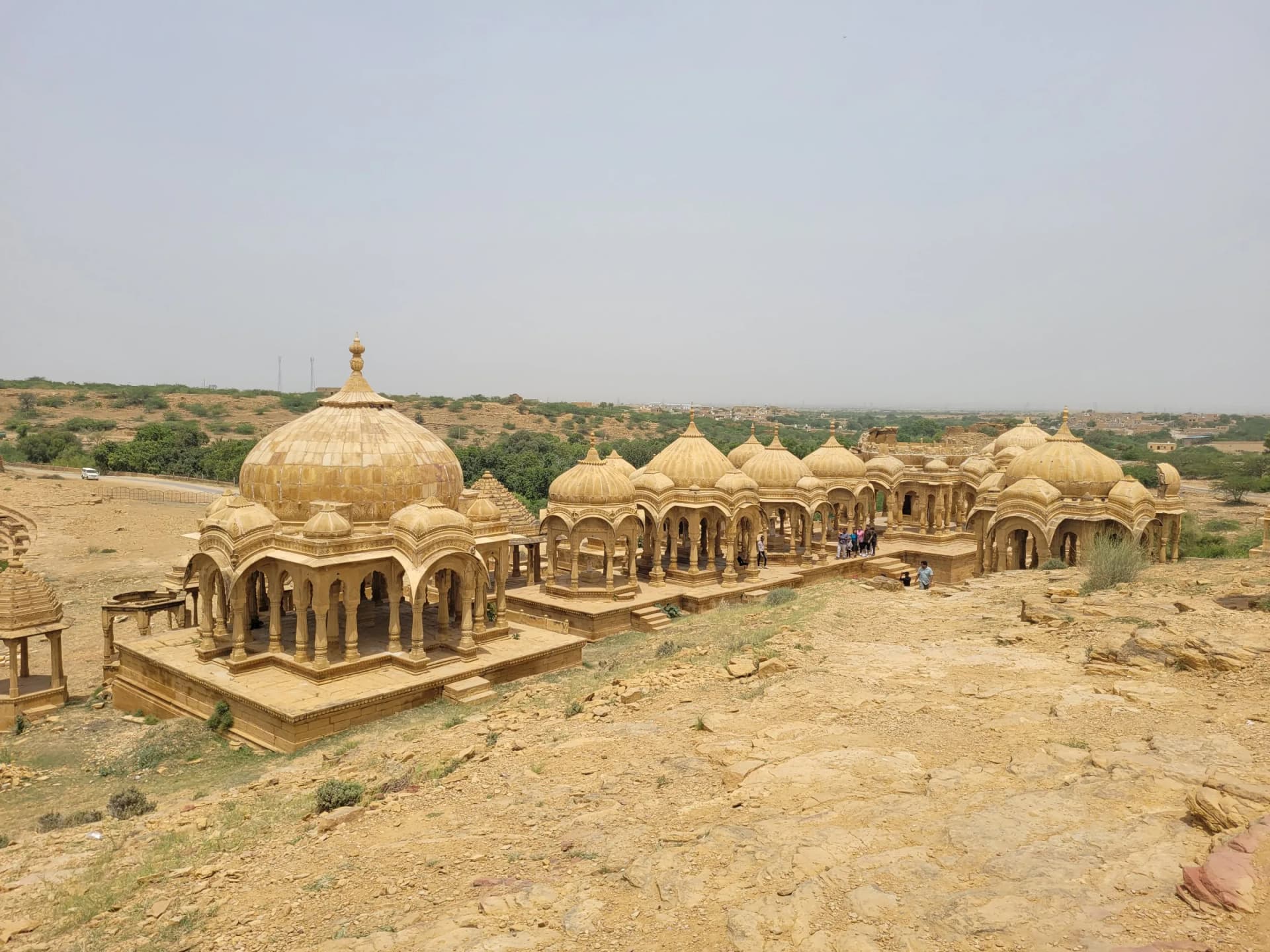
What it is: the cremation ground of Jaisalmer's Bhati rulers, 6 to 7 km north of town on a hill above a 16th-century dam and tank commissioned by Maharawal Jait Singh. Dozens of sandstone chhatris, domed pavilions on carved pillars, step up the slope, with wind turbines on the ridge behind.
Why go: it is the most photogenic hour in Jaisalmer, either at sunrise when the light comes across the desert from the east, or at sunset looking back from the hill above.
Time needed: about an hour, plus 20 minutes each way from town by auto or cab.
Tip: the site charges a small entry fee (published sources list ₹20 to ₹50 for Indian visitors) and a camera fee; carry cash. In winter, sunrise is around 7.30 am, so leave town by 7.
6. Gadisar Lake
What it is: the town's old reservoir, first built in 1156 by Rawal Jaisal and rebuilt around 1367 by Rawal Gadsi, about 1.5 km south of the fort. Ghats, small shrines and chhatris ring the water, and the fort stands on the ridge behind.
Why go: it is the calmest place in town, best at dawn when the light is on the shrines or at dusk when the fort turns gold above it.
Time needed: 30 to 45 minutes.
Tip: entry is free. Boats are available but add little; walk the ghats instead. The Desert Culture Centre by the gate is worth a look if you are interested in Manganiyar music and puppetry.
7. Salim Singh Ki Haveli
What it is: the early 19th-century mansion of Salim Singh, prime minister of the Jaisalmer state, built over the remains of an older haveli. Its upper storey flares outwards on carved brackets, which is why it is often compared to a peacock's tail or a ship's stern.
Why go: the silhouette is unlike any other haveli in Rajasthan, and it is five minutes from Patwon ki Haveli and ten from Gadisar, so it costs nothing to add.
Time needed: 20 to 30 minutes.
Tip: open roughly 8 am to 6 pm with a small entry fee for Indian visitors (published figures range from ₹20 to ₹50) and a camera fee. The exterior is the point; if you have time for only one interior, choose Kothari's Patwa Haveli instead.
8. Sam Sand Dunes
What it is: the main dune field about 40 km west of Jaisalmer, with sand rising up to 60 metres, hundreds of camps, camel and jeep rides, and the camel races of the Desert Festival each February.
Why go: the dunes are the tallest and most extensive near Jaisalmer, and at sunset the light on them is spectacular.
Time needed: an hour at sunset, or a full night if you prefer the big-camp atmosphere.
Tip: the sand is free to walk on. Expect crowds, jeeps on the slopes and dinner shows that end with DJs at most large camps. If you want quiet, sleep at Khuri and visit Sam in the early morning, when it is nearly empty. Treat jeep dune bashing and quad bikes with caution: they are run by private operators with little oversight, so insist on seat belts and a sober driver, and skip them with children.
Worth adding with an extra day
Longewala and Tanot: the 1971 war memorial at Longewala (about 111 km north-west, open daily except Sundays according to published listings) and the BSF-run Tanot Mata temple (about 120 km) make a 250 km round trip on straight, empty roads. Carry original photo ID, fuel up in town and at Ramgarh, and note that the border viewing circuit beyond Tanot needs an online pass from the Shri Tanot Mata Mandir Trust website, applied for by every adult individually. Foreign nationals are not permitted.
Desert National Park: 3,162 sq km of dunes, rock and salt flats, about 44 percent of it sand, and one of the last homes of the critically endangered great Indian bustard, along with chinkara, Indian wolf and wintering raptors. Jeep safaris from the Sudasari gate near Khuri are best at dawn in winter; confirm permits and fees with the forest office in Jaisalmer and go with a registered guide.
What to skip
- Staying inside the fort, for conservation reasons.
- Large Sam camp packages with DJs if you came for quiet and stars.
- Multi-day camel safaris on a first visit; one sunset ride covers the experience.
- Boating on Gadisar Lake.
- Kuldhara after dark; it closes, and the ghost story is the least interesting thing about it.
Putting it together
Day one: fort at 7 am, havelis late morning, Kuldhara in the last hour of light, Khuri for the night. Day two: dunes at dawn, Bada Bagh on the way back, Gadisar and the rooftops in the afternoon. A third day adds Longewala and Tanot or a Desert National Park safari. The hour-by-hour version is in the 2-day Jaisalmer itinerary, costs are in the Jaisalmer trip cost guide, and you can set dates in the trip planner. If you are building a wider circuit, Jodhpur is 300 km east on the same railway line.