
Two full days in Jaisalmer between overnight trains from Delhi: fort, havelis, Kuldhara at sunset and a Khuri desert night on Day 1; dunes at dawn, Bada Bagh, Gadisar and the 16:45 train on Day 2.
Quick summary
Jaisalmer is 921 km from Delhi by rail and about 770 km by road, so two days here means two full days on the ground with an overnight train on either side. This plan is built around the daily Runicha Express: leave Old Delhi at 17:35 on Day 0, arrive at 11:55 the next morning, spend that afternoon settling in, do two full days, and take the 16:45 train back on the evening of Day 2 to reach Delhi at 11:15 the following morning. It needs one day off work on each side of a weekend, which is the honest minimum for Jaisalmer. For background on the town, routes and seasons, start with the Jaisalmer destination guide.
Before you go: light and hours
- Sunrise and sunset in Jaisalmer (computed for the town's coordinates): mid-October about 6.45 am and 6.20 pm; mid-November 7.05 am and 5.55 pm; mid-December 7.25 am and 5.55 pm; mid-January 7.35 am and 6.15 pm; mid-February 7.25 am and 6.40 pm. Everything below assumes December to January; shift the desert timings 20 to 40 minutes later in October and February.
- Jain temples in the fort: open to visitors 8 am to 12 noon. Palace museum: about 9 am to 6 pm in winter. Government-run Patwon ki Haveli: about 9 am to 5 pm; Kothari's Patwa Haveli museum: 8 am to 7 pm. Kuldhara and Bada Bagh: about 8 am to 6 pm. Check boards at the gate; hours change.
- Train check: confirm the 14659 and 14660 timings on NTES or IRCTC a few days before travel.
Day 0: the train from Delhi
Board the 14659 Runicha Express at Old Delhi (17:35) or Delhi Sarai Rohilla (17:50). Sleeper or 3AC both work; 3AC is quieter and warmer in winter. Carry dinner or order on board, sleep through Jaipur and Jodhpur, and wake to desert scrub beyond Pokhran. Arrival at Jaisalmer is 11:55.
Arrival afternoon: settle in and see the fort from below
12.15 pm: to the old town
Take an auto from the station to a guesthouse in the old town below the fort, around Gandhi Chowk or towards Gadisar. Ignore camp touts at the station; book your desert night in advance or through your guesthouse. Lunch at a thali place in the lanes: ker sangri, bajra roti, gatte ki sabzi.
2.30 pm: rest
Even in January the early-afternoon sun is strong and you have slept on a train. Rooftop chai with the fort above you is a legitimate use of the hour.
4.15 pm: Gadisar Lake and Salim Singh Ki Haveli
Walk 15 minutes to Gadisar Lake, about 1.5 km south of the fort, for the ghats and shrines with the fort on the ridge behind. Entry is free; skip the boats. On the way back, pass Salim Singh Ki Haveli to see the flared, peacock-like upper storey in evening light; it closes around 6 pm if you want to go in.
5.30 pm: sunset from a rooftop
Be on a rooftop in the old town by 5.30 pm to watch the fort turn from gold to orange to grey and then floodlit. Dinner there or in the lanes. Early night; tomorrow starts at 6.45 am.
Day 1: fort and havelis, then into the desert
6.45 am: walk into the fort
Climb the ramp through the four gateways while the shops are shuttered and the lanes empty. The sandstone goes from grey to gold as the sun rises around 7.30. Walk to the western ramparts for the view over the town to the desert.
8 am: the Jain temples
The seven Jain temples open to visitors at 8 am and close at noon. Allow an hour for the carved pillars and ceilings and thousands of figures in yellow stone. Shoulders and knees covered, shoes and leather items left outside.
9.15 am: the palace museum, then breakfast
The Raj Mahal palace museum opens around 9 am in winter; the rooftop gives the best view inside the fort. About 45 minutes. Walk down to Gandhi Chowk for parathas and chai by 10.15.
10.45 am: the havelis
Patwon ki Haveli's lane is best when the sun reaches the facades mid-morning. Go into Kothari's Patwa Haveli museum for the painted rooms and mirror work (or the government-run haveli if you prefer the cheaper ticket), then walk past Nathmal ki Haveli. About 1.5 hours on foot through the old town, with shops open now if you want to look at camel leather and mirror work.
12.30 pm: lunch and check-out
Thali lunch below the fort. Check out of the guesthouse and leave your main bag with them if they allow it; you only need an overnight bag for the desert. If you are not coming back to the same guesthouse, book the second night elsewhere now.
2.45 pm: leave for Kuldhara
Take a cab (about ₹2,000 per car for the afternoon and the next-morning return is a reasonable estimate) or the camp's pick-up. Kuldhara is about 18 km west, 30 to 40 minutes.
3.30 pm: Kuldhara
An hour in the abandoned village: roofless houses on a grid, the temple, the stepwell, a few restored houses to show the plan. Entry is a small fee per person plus a vehicle charge. Leave by 4.30 pm so that you reach the dunes before sunset; in December the sun sets just before 6 pm, so there is no slack.
5.15 pm: Khuri
Kuldhara to Khuri is roughly 35 km of quiet desert road, about 45 minutes. Reach the camp by 5.15 pm, drop bags and walk or ride a camel out to the dunes for the last light at about 5.55 pm. Dinner by the fire, a local singer if you chose the camp well, and a sky with almost no light pollution. Nights fall to about 5°C in December and January: jacket, cap and socks.
Day 2: dunes at dawn, cenotaphs, a slow afternoon and the train
7 am: sunrise on the sand
Sunrise is around 7.30 am in midwinter. Walk out to the dunes by 7 for the colour change, then breakfast at the camp.
9 am: back towards town
Leave Khuri by 9. Khuri to Jaisalmer is 40 to 50 km, about an hour. If you want the big-dune photograph, a detour to Sam Sand Dunes at this hour finds it nearly empty, but it adds about an hour; skip it if you prefer Bada Bagh unhurried.
10.30 am: Bada Bagh
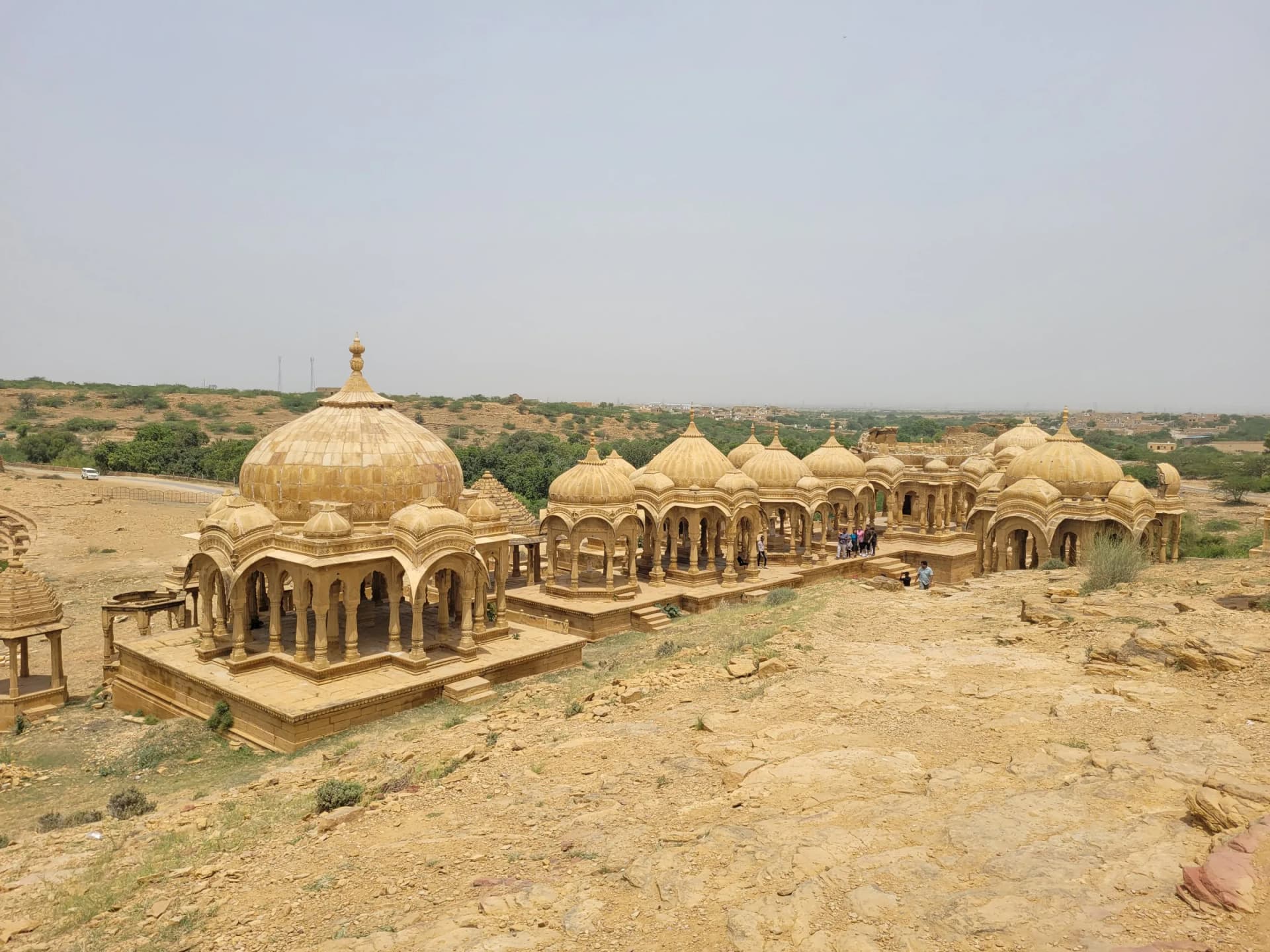
Six to seven kilometres north of town: dozens of royal cenotaphs stepping up a hill above a 16th-century dam, wind turbines behind. Small entry and camera fees. An hour is enough.
12 pm: lunch and the rooftops
Back in the old town, collect your bag and have a long lunch. Spend the early afternoon at Gadisar if you missed it, at the Desert Culture Centre by its gate if you are curious about Manganiyar music and puppetry, or simply on a rooftop. Buy ghotua laddu at Gandhi Chowk for the train.
3.45 pm: to the station
The 14660 Runicha Express leaves Jaisalmer at 16:45. Be at the station by 4.15 pm. It reaches Delhi Sarai Rohilla at 10:48 and Old Delhi at 11:15 the next morning.
Swaps and variations
If you fly in
Winter-schedule direct flights (IndiGo and Air India, about 1 hour 45 minutes, from 25 October 2026 for the 2026–27 season) put you in Jaisalmer by late morning. Run the arrival afternoon as above, then Day 1 and Day 2 unchanged, and fly out the evening of Day 2 or the next morning. Outside the winter schedule, fly to Jodhpur and take the train or a cab for the last 300 km.
If you drive
Allow two days each way with a stop at Bikaner (about 440 km from Delhi, then 330 km to Jaisalmer) or Jodhpur (about 594 km, then 305 km). Do not drive the Pokhran–Jaisalmer stretch after dark. With your own car, Kuldhara and Khuri need no cab, and Bada Bagh can be done at sunrise before leaving town on the last morning.
If you have a third day: Longewala and Tanot
Leave by 7 am with a full tank, water and original photo ID. Ramgarh for chai and fuel, Tanot Mata temple (about 120 km) by mid-morning, Longewala war memorial (about 111 km from town, 40 km from Tanot) around noon for the tanks, bunkers and museum, and back to Jaisalmer by 4 pm: roughly 250 km of straight, empty road. The memorial is reported to close on Sundays, so plan a weekday. The border viewing point beyond Tanot needs an online pass from the Shri Tanot Mata Mandir Trust website, applied for separately by every adult, with two printed copies and the original ID carried on the day; foreign nationals are not permitted. Sleep in town that night and take the morning or afternoon train.
If you want wildlife instead
Replace the Sam detour on Day 2 with a dawn jeep safari from the Sudasari gate of Desert National Park near Khuri, for great Indian bustard, chinkara and wintering raptors. Arrange it through your camp the evening before, confirm fees and permits with the forest office, and use a registered jeep and guide.
Packing
- Warm jacket, cap and socks for the desert night; camps give blankets but 5°C is 5°C
- Hat, sunscreen, sunglasses, two litres of water per person per day
- Scarf for dust on the desert roads
- Walking shoes for the fort ramp and the dunes; modest clothing for the Jain temples
- Torch or headlamp for the camp
- Cash in small notes for monument tickets, camps and villages; original photo ID for any checkpoint
Fort at dawn, havelis at mid-morning, Kuldhara in the last light, Khuri under the stars, Bada Bagh on the way back and the 16:45 train home. That is Jaisalmer in two days. Costs for each band are in the Jaisalmer trip cost guide, the full ranking of sights is in the guide to the best places to visit in Jaisalmer, and you can set your own dates in the trip planner. If you can add two more days, break the return journey at Jodhpur.