
Seven places to visit in Rishikesh with what each involves, time needed and practical tips, plus the 2026 status of Laxman Jhula, Bajrang Setu and Ram Jhula.
Quick summary
Most of the places to visit in Rishikesh sit within 10 km of each other along the Ganga, and only Kunjapuri needs a dedicated early start. If you have one weekend, these are the top picks:
- For the river: raft the Shivpuri stretch with a licensed operator.
- For the evening: the Ganga aarti at Triveni Ghat or Parmarth Niketan.
- For a short walk: Neer Garh Waterfall above Tapovan.
- For a sunrise: Kunjapuri Devi Temple, about 25 km up the hill.
- For history: the Beatles Ashram (Chaurasi Kutia), open 10 am to 4 pm.
Before you plan any walks, note the bridge situation. Laxman Jhula has been closed since July 2019, Bajrang Setu has been built beside it, and Ram Jhula was closed completely in July 2026 for repairs expected to last until December 2026. Use Janki Setu to cross between Muni Ki Reti and Swargashram in the meantime. For the overall picture of the town, routes and seasons, start with the Rishikesh destination guide.
1. Triveni Ghat
What it is: the largest bathing ghat in the old town on the west bank, associated with the traditional meeting of the Ganga, Yamuna and Saraswati.
Why go: the evening Ganga aarti here is a large, mostly local gathering with lamps floated on the river, and the bazaar behind the ghat is the best place in town for evening chaat, kachori, jalebi and sweets.
Time needed: about 1.5 hours including the bazaar.
Tip: the aarti starts around sunset, roughly 5.30 pm in winter and 6.30–7 pm in summer; confirm locally and arrive 30–45 minutes early. The current is strong even beside the steps, so stay within knee depth if you go in.
2. Shivpuri
What it is: a strip of rafting camps, resorts and dhabas on the Badrinath highway, about 16 km upstream of Laxman Jhula, and the start of the most popular Ganga rafting run.
Why go: the Shivpuri stretch (roughly 16–18 km down to Rishikesh) has enough Grade II and III rapids to be exciting for fit first-timers and is the best-value half day in Rishikesh. Indicative rates were around ₹1,000 per person in 2025.
Time needed: about 2.5–3.5 hours including briefing and transfers (estimate; operators vary).
Tip: raft only with a licensed operator, insist on a certified life jacket and helmet for everyone, and book the first morning slot. Rafting is suspended from 1 July each year and resumes after the post-monsoon inspection; in 2026 it restarted on 23 September. Shorter (Brahmpuri) and longer (Marine Drive, Kaudiyala) runs are also available.
3. Laxman Jhula and Tapovan
What it is: the closed 1920s suspension bridge, the new Bajrang Setu beside it, and the Tapovan district of cafes, hostels, yoga schools and rafting offices above.
Why go: Bajrang Setu's glass walkways give a view straight down to the river. The central deck is free and open round the clock; the walkways are open 6 am to 10 pm with an approved fee of ₹100 per adult and ₹50 per child for a two-hour slot. Check on arrival that the walkways are open.
Time needed: 1–2 hours, more if you settle into a cafe.
Tip: come on a weekday morning or early in the day at weekends. Parking fills by late morning, so walk in from your stay, and keep bags closed around the monkeys.
4. Neer Garh Waterfall
What it is: a stream dropping through tiered falls and pools in the forest about 5 km from Laxman Jhula, reached by a trail of roughly 1.5–2 km from a ticket gate.
Why go: it is the easiest nature walk from town, shaded for much of the way and fullest from late September to November after the monsoon.
Time needed: 2–3 hours round trip from Tapovan.
Tip: wear shoes with grip, as rocks near the water are slippery. A small entry fee is charged at the gate. Keep out of the pools and stream beds during or after heavy rain, when levels can rise quickly.
5. Beatles Ashram (Chaurasi Kutia)
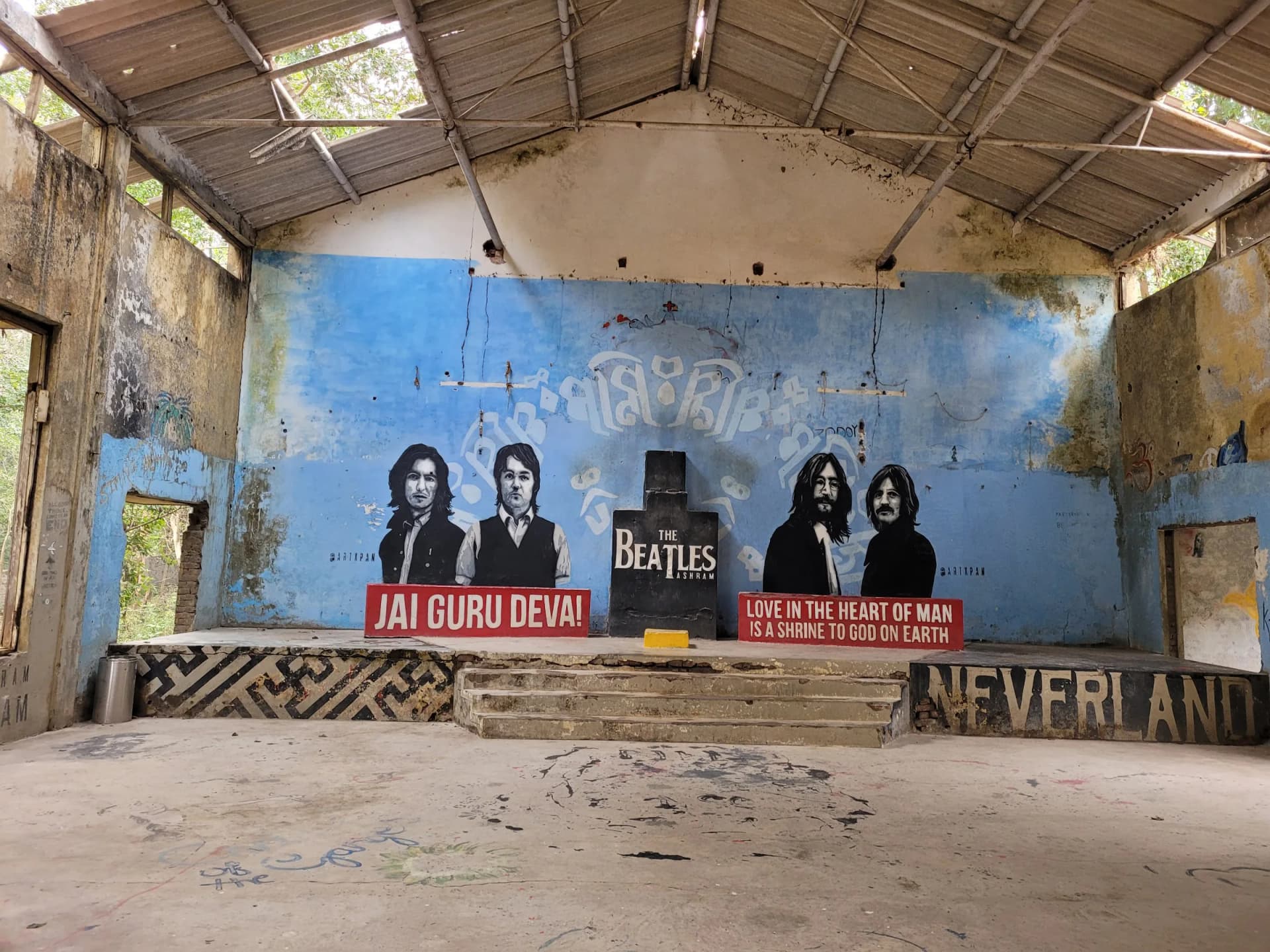
What it is: Maharishi Mahesh Yogi's former meditation academy, now inside Rajaji Tiger Reserve, where the Beatles stayed from February to April 1968. It opened to visitors in December 2015.
Why go: dome-shaped meditation huts, ruined hostel blocks and a lecture hall covered in murals, all in quiet forest at the southern end of Swargashram.
Time needed: 1–1.5 hours.
Tip: it is open 10 am to 4 pm. Foreign nationals pay a much higher fee (₹1,200 as of 2025) and should carry a passport; Indian visitors pay a lower fee, so confirm the rate at the gate. Stay on the paths, as some structures are crumbling.
6. Ram Jhula
What it is: the 1986 suspension bridge linking Sivananda Nagar in Muni Ki Reti with Swargashram, home to Parmarth Niketan and Gita Bhawan.
Why go: the Swargashram side holds the Parmarth Niketan ghat, where a well-organised Ganga aarti takes place at sunset, and lanes of ashrams and shops.
Time needed: 1–2 hours including the aarti.
Tip: the bridge itself was closed in late July 2026 for repairs expected to run until December 2026, and two-wheelers have been barred since 2023. Cross on Janki Setu instead and check local news for reopening.
7. Kunjapuri Devi Temple
What it is: a Shakti Peeth on a hilltop near Hindolakhal in Tehri Garhwal, at about 1,676 m and roughly 25 km by road from Rishikesh.
Why go: the sunrise. On clear mornings, especially from November to February, you see across the Ganga valley to peaks including Swargarohini, Bandarpunch and Chaukhamba.
Time needed: 3–4 hours round trip.
Tip: leave about an hour and a quarter before sunrise, which ranges from roughly 6 am in October and late March to after 7 am in late December and January. Drive the hairpins slowly in the dark and carry a warm layer.
Further afield
- Vashishta Gufa: a meditation cave about 22–25 km up the Badrinath highway, beside the river. Best for those with a specific interest in meditation.
- Neelkanth Mahadev Temple: a major Shiva temple about 32 km by road from Rishikesh, on a forest road. Very crowded during the Kanwar Yatra in Shravan (usually July–August); go on a weekday.
- Devprayag: about 70 km up the Badrinath highway, where the Alaknanda and Bhagirathi meet to form the Ganga. A full half-day out; avoid during monsoon landslide alerts.
- Rajaji Tiger Reserve (Chilla zone): morning and evening jeep safaris from 15 November to 15 June; Indian visitors pay ₹150 entry plus vehicle charges.
How to fit it into a weekend
Arrival day suits Neer Garh, Bajrang Setu and an evening aarti. Keep the second morning for rafting, then visit the Beatles Ashram before it closes at 4 pm. If you can stay a third night, add Kunjapuri at sunrise. The full timed plan is in the 2-day Rishikesh itinerary, costs for rafting, stays and transport are in the Rishikesh trip cost guide, and the season-by-season detail is on the best time to visit Rishikesh page. To save a custom version, use the trip planner.