
How to do Jaipur from Delhi NCR: routes by road and train, when to go, where to stay by area, the forts and the walled city, the food that matters, tickets and timings, and how to avoid the tourist traps.
Jaipur in brief
Jaipur is the capital of Rajasthan, a city of about five million on the eastern edge of the Aravalli hills, roughly 280 km south-west of Delhi. It was founded in 1727 by Jai Singh II as a planned grid city below the older capital at Amber, painted pink in 1876 for a royal visit, and has stayed that colour by law inside the walls. Three hill forts, a royal palace still in use, an astronomical observatory on the UNESCO list, and dense bazaars make it the most complete heritage city within a day of Delhi.
How to reach Jaipur from Delhi NCR
By car or motorcycle
Two routes. NH48 through Gurugram, Manesar, Behror, Kotputli and Shahpura is the classic, about 280 km and 4.5 to 5.5 hours depending on how Gurugram and the Manesar toll treat you. The road is six lanes most of the way with reliable dhabas. Tolls are about 500 to 600 each way for a car. The Delhi–Mumbai Expressway from Sohna to Dausa is faster and emptier for the first 200 km, then you turn west on NH21 to Jaipur; total around 300 km and 4 to 4.5 hours. Two-wheelers are not permitted on the expressway, so motorcycles take NH48.
By train
The Vande Bharat and the Ajmer Shatabdi from New Delhi reach Jaipur in about 4 to 4.5 hours; the Double Decker and several intercity trains take 5 to 6. Jaipur Junction is 3 km from the walled city. This is the least stressful option on long weekends.
By bus
RSRTC Volvos and sleepers from Dhaula Kuan and Kashmere Gate ISBT run all day and night, 500 to 1,200 rupees, 5 to 6 hours, arriving at Sindhi Camp bus stand near the station.
Best time to visit
November to February is ideal: mornings of 8 to 12 degrees, afternoons around 25, clear skies and sharp light on the forts. October and March are warm but fine, with the Jaipur Literature Festival in late January and Holi in March drawing crowds. April to June is brutal, 40 to 45 degrees; the city is only doable at dawn and after dark, hotel prices drop, and I would not come on a motorcycle. July to September is monsoon, humid with dramatic skies over Nahargarh and green in the Aravallis; the Teej festival in July or August is worth seeing.
Where to stay
Inside the walled city
Havelis and guesthouses in the old quarters around Chandpol, Tripolia and Johari Bazaar, 1,500 to 6,000 a night. You walk to everything, wake up to the bazaars, and deal with narrow lanes, noise and no parking. Good for a first visit if you come by train.
C-Scheme, Bani Park and MI Road
The colonial-era and mid-century neighbourhoods just outside the walls, 10 minutes from the old city. Heritage hotels in converted mansions, boutique stays and mid-range chains, 2,500 to 12,000. Cafes, restaurants and parking. This is where I would stay with a vehicle.
Amber and the north
A few resorts and heritage properties near Amber Fort, Kukas and the Delhi road, 4,000 to 30,000. Quiet, close to the forts, 30 to 45 minutes from the old city. Good for a fort-focused trip or a splurge.
Budget
Hostels in Bani Park and near the station from 400 a bed; dharamshalas and cheap hotels around Sindhi Camp from 800.
The forts
Amber Fort opens at 8 am and this is when to be there. Two to three hours for the palaces; walk up from the lake road. Jaigarh, on the ridge above and connected by a path, has the Jaivana cannon and the best views; an hour. Nahargarh is for sunset, with the city below and a restaurant inside; the 6 km road up from the city is a fine ride. A loop from Amber to Jaigarh along the ridge to Nahargarh and down into the city is the best half-day drive in Jaipur.
The walled city
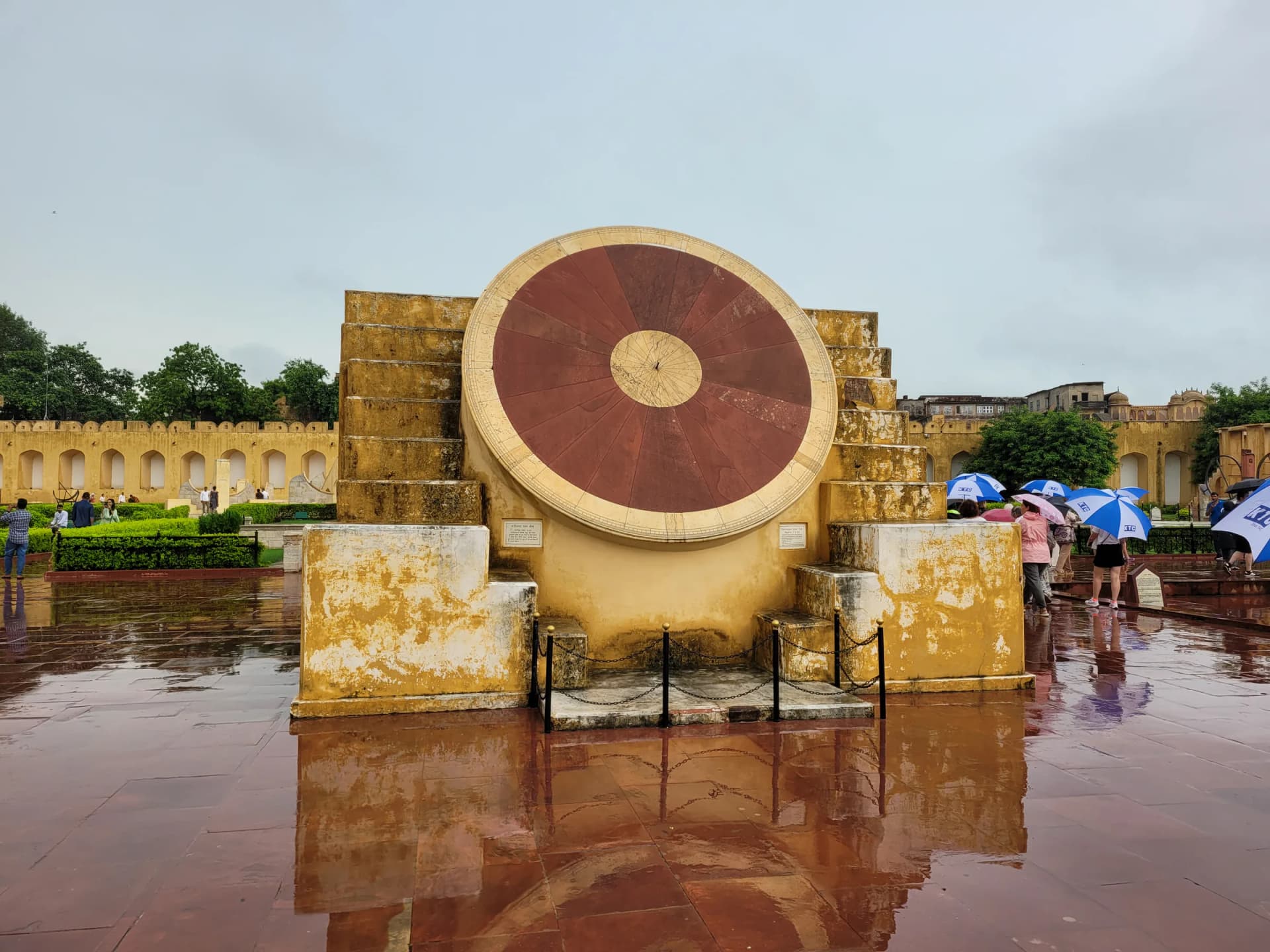
Start at Badi Chaupar with the Hawa Mahal facade at sunrise from a rooftop cafe across the road. Walk to the City Palace (90 minutes) and Jantar Mantar (45 minutes) behind it. Loop through Johari Bazaar for jewellery and textiles, Bapu Bazaar for juttis and quilts, and Tripolia for brass and lac bangles. The Albert Hall museum, just outside the walls at Ram Niwas garden, is a handsome Indo-Saracenic building with a decent collection and an Egyptian mummy, and looks best floodlit at night.
Tickets and timings
Buy the composite ticket from the Rajasthan tourism department at any of the monuments: it covers Amber, Nahargarh, Jantar Mantar, Hawa Mahal, Albert Hall, Sisodia Rani garden and Vidyadhar garden, is valid for two days, and costs a few hundred rupees for Indians. It does not cover the City Palace or Jaigarh, which have their own tickets. Most monuments open 8 or 9 am to 5 or 5.30 pm; Amber and Nahargarh have separate evening light-and-sound or night entry in season. Monday closures do not apply to the main sights, but check the City Palace for royal events.
Food
Jaipur is a food city. Pyaaz kachori at Rawat near the station, lassi in a clay cup at Lassiwala on MI Road before it runs out by early afternoon, ghewar and mishri mawa at LMB in Johari Bazaar, dal baati churma at any of the old-school thali places, laal maas at a Rajput-style restaurant, and everything at once at Masala Chowk, the open-air food court at Ram Niwas garden. Tapri on C-Scheme is the tea-and-snacks institution. Budget 150 to 300 for street food meals and 600 to 1,200 for a sit-down thali or a laal maas dinner.
Shopping
Block-printed textiles, quilts, blue pottery, juttis, lac bangles and silver. Bapu and Johari bazaars for the classic haggling experience; Anokhi and a handful of fixed-price stores for quality without the negotiation. Sanganer, 15 km south, is the block-printing village if you want to see it made.
Getting around
Autos and cab apps work well. A full-day cab for the forts and the old city is 1,800 to 2,500. The walled city is best on foot; drive to Amber and Nahargarh. Traffic is heavy from 10 am to 8 pm, and parking inside the walls is close to impossible; use the lots at Chandpol and Ramganj or park outside and walk.
Day trips
- Sambhar Salt Lake, 80 km west: a white salt flat, a narrow-gauge salt railway and flamingos in winter. A superb motorcycle ride.
- Abhaneri Chand Baori, 95 km east on the Agra road: the most spectacular stepwell in India, 13 storeys deep.
- Bhangarh Fort, 85 km: the famously haunted ruined town, atmospheric and empty on weekdays.
- Sanganer and Bagru, 15 to 30 km: block-printing villages.
How long to stay
Two nights covers the forts, the walled city and the food. Day one: arrive by lunch, Nahargarh sunset. Day two: Amber at 8, Jaigarh and Panna Meena, the walled city in the afternoon, Masala Chowk for dinner. Day three: Galtaji at dawn, breakfast, drive home. A third night adds a day trip to Abhaneri or Sambhar, or simply lets you eat more slowly.
Traps to avoid
- Elephant rides at Amber.
- Guides and gem-shop touts at the fort gates and in Johari Bazaar; the gem scam is old and still running.
- The ethnic-village dinner shows on the city outskirts, unless you are travelling with children who will enjoy the camel.
- Arriving at Amber at 11 am in any month.
- Rooftop restaurants on the Hawa Mahal square for anything other than a chai and a photograph.