
Places to visit in Jaipur at a glance: what each sight is, why it is worth it, how long to give it and one practical tip, plus 2026 ticket prices, day trips and what to skip.
Quick summary
The best places to visit in Jaipur are Amber Fort, Nahargarh Fort at sunset, the walled-city trio of Hawa Mahal, City Palace and Jantar Mantar, Panna Meena ka Kund, Jaigarh Fort, Galtaji Temple and the Albert Hall Museum. With two days you can see all of them if you plan around opening hours, crowds and the light. Below is each place with what it is, why it is worth your time, how long to give it and one practical tip, followed by day trips and what you can safely skip.
Top picks at a glance
- Amber Fort: the one sight not to miss. 2 to 3 hours, early morning.
- Nahargarh Fort: the best sunset view over the city. 2 hours, late afternoon.
- Hawa Mahal, City Palace and Jantar Mantar: the walled-city core, all close together. Half a day.
- Panna Meena ka Kund: a geometric stepwell five minutes from Amber Fort. 20 to 30 minutes.
- Jaigarh Fort: the ridge-top fort above Amber with the Jaivana cannon. About an hour.
- Galtaji Temple: a temple complex in a rocky gorge east of the city. 1.5 hours, early.
- Albert Hall Museum: Jaipur's main museum, best seen floodlit after dark. 1 to 1.5 hours.
If you are planning the whole trip, the 2-day Jaipur itinerary puts these in a workable order, and the Jaipur destination guide covers routes from Delhi NCR and where to stay.
1. Amber Fort
What it is: the hilltop palace-fort of the Kachwaha rulers above Maota Lake, north of the city, and part of the UNESCO-listed Hill Forts of Rajasthan.
Why go: the mirrored Sheesh Mahal, the courtyards of the Diwan-i-Aam and Diwan-i-Khas, and the Man Singh palace at the back, which many tour groups skip.
Time needed: 2 to 3 hours.
Tip: arrive by 8 am and walk up the ramp from the lake road. The state's official booking portal currently lists Amber Fort hours as 7 am to 8 pm, while many guides still say 8 am, so check the portal before you go. Mid-morning, when the coaches arrive, is the worst time. Indian adults pay ₹200 on its own, or use the composite ticket (see the end of this article).
2. Nahargarh Fort at sunset
What it is: a fort on the Aravalli ridge directly above the old city, reached by a winding road through the hills.
Why go: the ramparts look straight down onto Jaipur, and at dusk the city lights come on below you. Madhavendra Bhawan, a set of linked royal apartments inside, is worth a short walk-through.
Time needed: about 2 hours, ending at sunset.
Tip: the official portal lists Nahargarh as open 10 am to 10 pm, but several visitor guides report that the ticket window stops issuing day entry around 5 pm, with those already inside allowed to stay for sunset. Get in by 4.30 pm to be safe. Sunset falls between roughly 5.30 and 6.45 pm from October to March. Padao, the RTDC cafeteria at the fort, has its own small entry charge.
3. Hawa Mahal
What it is: the five-storey pink sandstone screen of latticed windows on the edge of the old city, built so royal women could watch the street unseen.
Why go: it is the image of Jaipur, and the facade alone justifies the stop.
Time needed: 15 minutes for the facade; 45 minutes if you go inside.
Tip: the facade faces east and looks best in morning light from the street opposite. The rooftop cafés across the road do not open at sunrise, so plan a café view for later in the morning instead. The interior opens at 9 am.
4. City Palace
What it is: the royal palace complex at the centre of the walled city, part of which is still the royal family's residence.
Why go: the courtyards, the painted gates of Pritam Niwas Chowk and the galleries of textiles, arms and royal costume.
Time needed: about 1.5 hours.
Tip: City Palace is run separately from the state monuments and is not on the composite ticket. Indian adults pay ₹400, or ₹500 for a combined ticket that adds Jaigarh Fort and the royal cenotaphs. It is open 9.30 am to 6.30 pm, with last tickets at 6 pm.
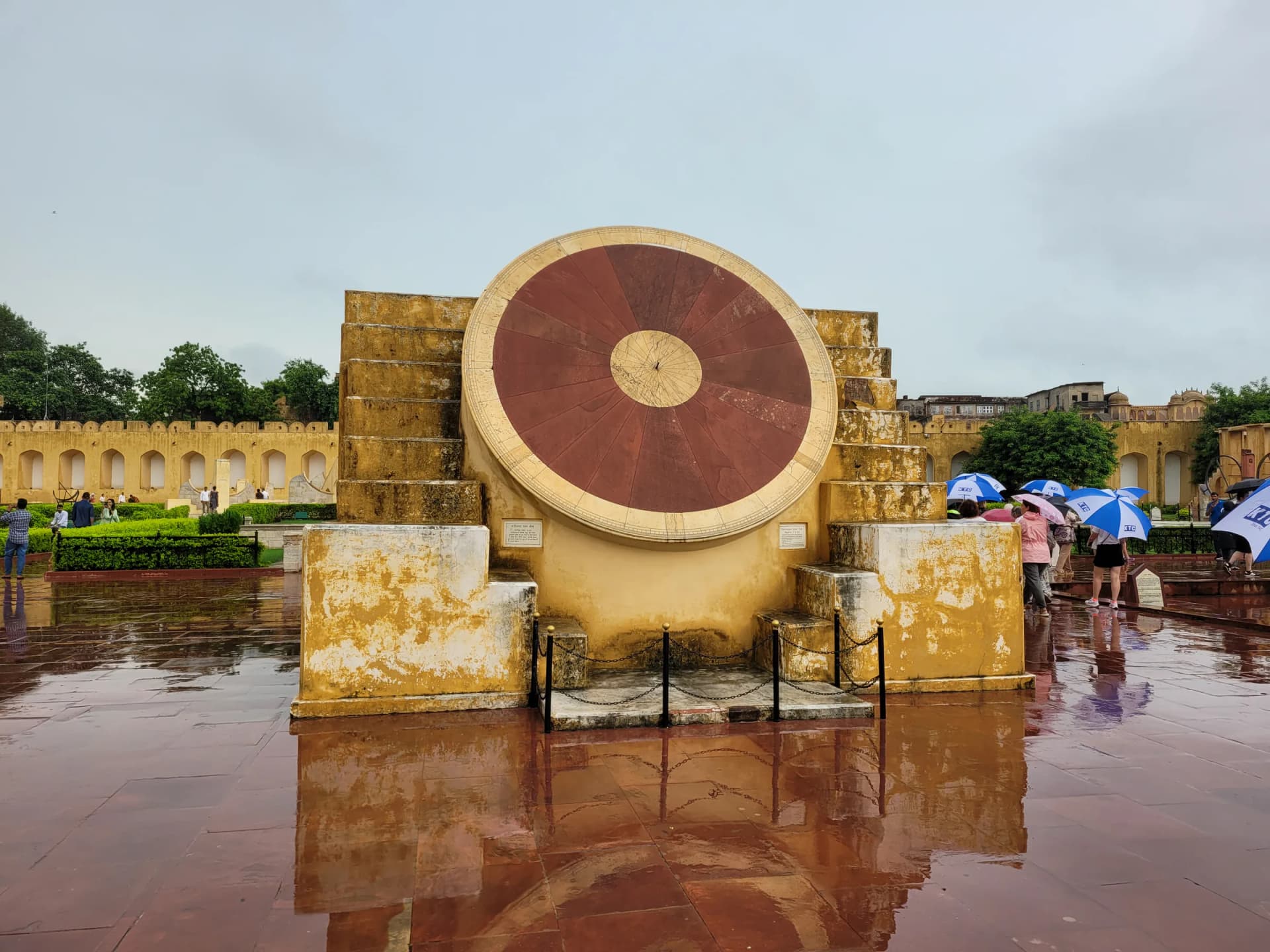
5. Jantar Mantar
What it is: an 18th-century astronomical observatory of giant masonry instruments next to City Palace, and a UNESCO World Heritage Site.
Why go: the scale. The great sundial is the size of a building, and the instruments still read time and celestial positions.
Time needed: 45 minutes.
Tip: go on a clear day so the shadows on the sundials are sharp, and consider a licensed guide if you want each instrument explained.
6. Panna Meena ka Kund
What it is: a 16th-century stepwell in Amber village with criss-crossing flights of steps on all sides.
Why go: it is one of the most photogenic places in Jaipur for very little time, and it is a few minutes from Amber Fort.
Time needed: 20 to 30 minutes.
Tip: there is no ticket, but guards usually stop visitors from walking down the steps, so plan to photograph it from the top.
7. Jaigarh Fort
What it is: the military fort on the ridge above Amber, connected to it by a fortified path.
Why go: the Jaivana cannon, the huge rock-cut water tanks and the best view down onto Amber Fort and Maota Lake. It is usually far quieter than Amber.
Time needed: about an hour.
Tip: do it straight after Amber, while you are already up the hill. The City Palace combined ticket covers it.
8. Galtaji Temple
What it is: a complex of temples and spring-fed tanks in a narrow gorge about 10 km east of the centre, known for its many monkeys.
Why go: the setting is unlike anything else in the city, and the walk up to the Surya temple on the ridge gives a view back over Jaipur.
Time needed: about 1.5 hours.
Tip: go early in the morning when it is cooler and quieter, keep food out of sight because of the monkeys, and combine it with Sisodia Rani garden on the same side of town.
9. Albert Hall Museum
What it is: the state museum, an Indo-Saracenic building in Ram Niwas garden just outside the walled city.
Why go: a broad collection of miniatures, textiles, arms and carpets, plus an Egyptian mummy, and a facade that is floodlit after dark.
Time needed: 1 to 1.5 hours.
Tip: the official portal lists it as open until 8 pm, so you can see it lit up and then eat at Masala Chowk, the open-air food court next door (₹10 entry).
10. Jal Mahal
What it is: a palace standing in Man Sagar lake on the road to Amber.
Why go: a pretty view from the lakeside promenade. You cannot go inside.
Time needed: 10 minutes.
Tip: treat it as a roadside stop on the way to Amber in the morning, not a destination.
11. Patrika Gate
What it is: a modern ornamental gate at Jawahar Circle in south Jaipur, painted on every surface in Rajasthani style.
Why go: colour and photographs. There is no history here.
Time needed: 20 minutes.
Tip: weekends bring queues for the empty-archway shot, so go early on a weekday or skip it if you are short of time.
12. Sanganer and Bagru
What it is: the block-printing towns south and west of Jaipur, where cloth is still printed by hand with carved wooden blocks.
Why go: to see the process, and to buy at source.
Time needed: half a day for one of them.
Tip: worth it only if textiles interest you; otherwise the bazaars of the old city are enough.
Day trips from Jaipur
Abhaneri Chand Baori
One of India's deepest and most dramatic stepwells, roughly 90 km east of Jaipur. Allow half a day including the drive. Abhaneri can be combined with Bhangarh for a long day out.
Bhangarh
The ruined town in Alwar district, famous for ghost stories. It is protected by the Archaeological Survey of India, and an ASI notice prohibits entry before sunrise and after sunset, so plan to be out well before dusk.
Sambhar Salt Lake
India's largest inland salt lake, west of the city: white salt flats, old salt works and, in winter, flamingos. Allow at least half a day.
For more ideas within driving distance of Delhi, see Rajasthan weekend trips.
What to skip
- Elephant rides at Amber. Walk up the ramp instead.
- Ethnic-village dinner shows on the outskirts, unless children in your group will enjoy the camel ride.
- Gem shops recommended by anyone who approached you first. The gem scam is long-running.
- Jal Mahal as a stop in itself. Look from the promenade and move on.
- The Hawa Mahal interior if you are short on time. The facade is the point.
Tickets in brief
The state archaeology department's composite ticket costs ₹550 for Indian adults and ₹180 for Indian students. It covers Amber Fort, Hawa Mahal, Jantar Mantar, Albert Hall Museum, Nahargarh Fort, Isarlat, Sisodia Rani garden and Vidyadhar garden. Bought separately, Amber Fort is ₹200 and Hawa Mahal, Jantar Mantar, Albert Hall and Nahargarh are ₹100 each, so the composite only saves money if you visit all five of those. City Palace and Jaigarh are not included. Panna Meena ka Kund and Galtaji Temple have no entry fee. For a full per-person breakdown, see Jaipur trip cost.
When to go
October to March is the comfortable season, with cool mornings that suit early starts at the forts. From April to June, sightseeing works only early in the morning and after about 5 pm. See the best time to visit Jaipur for month-by-month detail, or build your own plan with the trip planner.